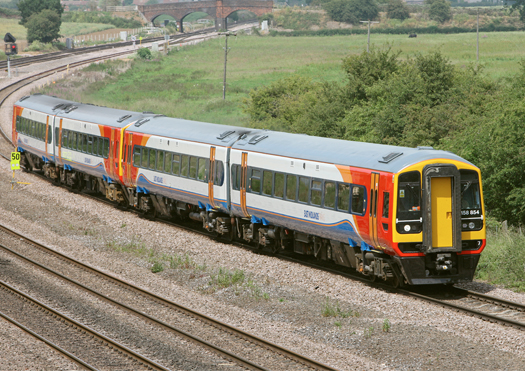
Train Journeys are the perfect opportunity to spend time thinking, and remove yourself from the materials and distractions of home, you are in the hands of the train driver, you don’t have to think about crossing the road safely, or the motorcyclist coming up on your inside, you can also admire the view as you go by.
Switch your phone off, take a pen and some paper that is all you need and you’re on your own, if you’re in luck and aren’t in a noisy rammed carriage, why not use this time to write down what you are thinking, if you feel too self-conscious you could just spend this time thinking what you are thinking, but it is good to write things down to reflect on them later.
***
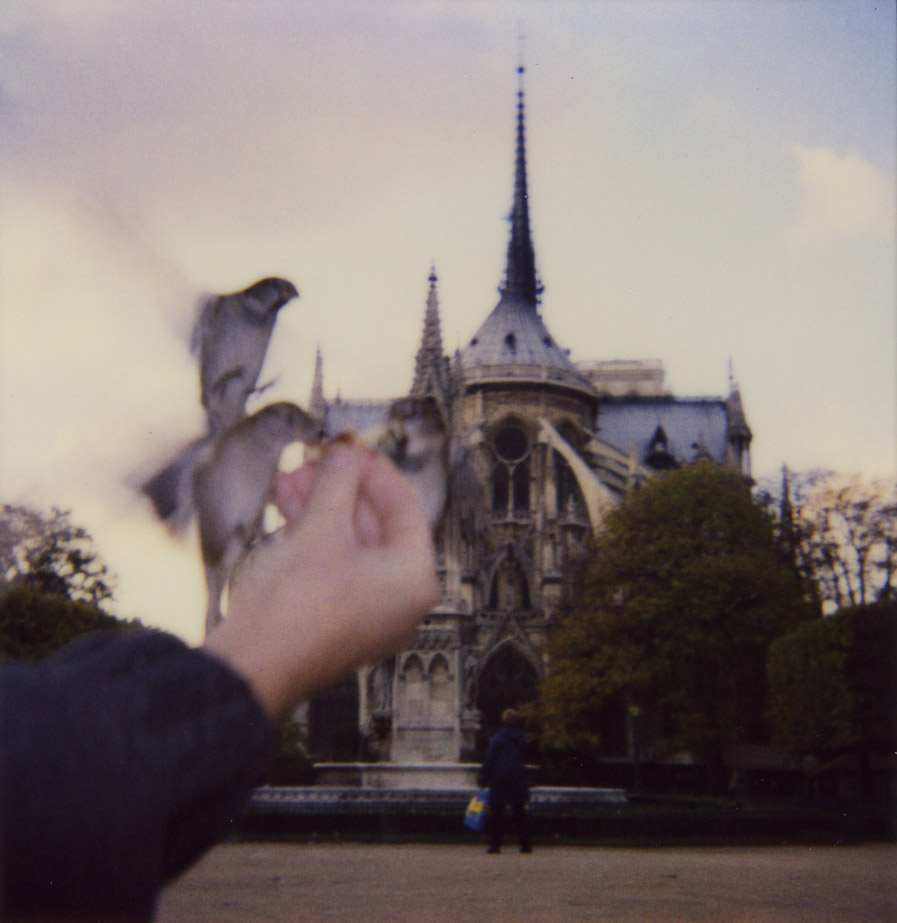
I took this photo in Paris, it was a polaroid of a friend feeding crepes to sparrows from her hand at the back of Notre Dame, and the train journey I was on one month later gave me the chance to reflect on why this was such a special photo, it obviously captured a memorable moment from a great time with friends in Paris but what else, so on a train I looked at this photo and wrote these words.
On the train from Swansea to Sleaford, one month on, I write these words:
5:37
All life is here
I’ve been trying to figure out what it means, why it has a hold over me, and one which I can’t seem to express in a simple sentence or paragraph or –
Perhaps I should detach myself and analyse it objectively and then tackle subjective qualities, work out whether it would be the same for others, if it’s universal, what can be universally recognised. Perhaps it’s all too obvious.
First, in the foreground, an arm, coming from the bottom left corner, a sign of a person, a hand protruding from a coat, at first glance you might think it belongs to the photographer but then you realise no. Not noticeably male or female, the hand is reaching out, giving, feeding, 3 birds, sparrows, in motion, hovering to feed on the food that is being shared with the birds, 2 creatures, living together, sharing, all life is here, in this simple gesture, living together in peace and harmony.
Then the background, Notre Dame – the Cathedral built by man to pay homage to creation, the creator, being photographed by a man, religion, Christianity, congregated, segregated into one place – photographed, archived, a monument to God, the gravestone and demise of this archaic form, the uncaptureable thing turned into something to be photographed, an object of beauty for, what could be seen as the divine, the omnipresent, the spiritual, the uncaptureable and, I can’t think of that word, I think it begins with an ‘e’, it is not ephemeral but it’s like beauty but more than that, like divine but more than that, and the fact that I can’t think of the word, seems somehow appropriate for the word that describes, that thing which is uncaptureable, indescribable. It is a photograph captured of uncaptureable ephemeral beauty, the moment, in front of a photograph of a photograph of something that attempts to capture that which is uncaptureable, disappearing, in decline, a monument stood still confronted with movement of life in the foreground, a celebration of what is here, now.
Perhaps I could talk about Barthes but perhaps not.
and maybe ephemeral is a better word.
Life is ephemeral, the moment, the sparrows, the hand, life, and that moment is gone, but the cathedral is stood still there, will it still be there when we are gone.
No wonder, it begins with ‘s’ but it does end in an ‘e’ – sublime.

